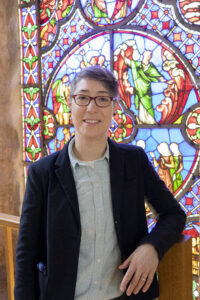
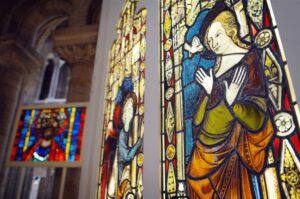
Artist conservator Isabelle Davies takes on the cleaning of hundreds of antiquated panes at Ely Cathedral.
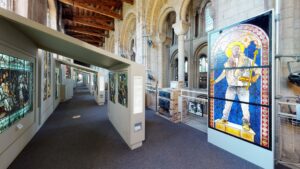
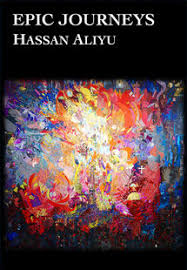
In this edition Simon Bertin features renowned Nigerian artist Hassan Aliyu, exhibiting at Wolfson College and Artspace 5-7; a visit to Ely Cathedral’s Stained Glass Museum with artist and conservator Isabelle Davies and curator Jasmine Allen; the Cambridge School of Art Degree Show; and Penny Heath’s Art Garden, where Penny and dressmaker-artist Brenda Mayo reflect on creativity and the city’s vibrant arts community.
Jasmine Allen Curator
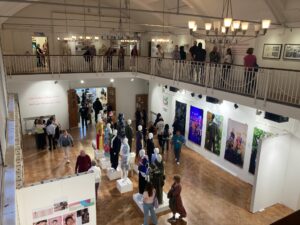
Cambridge School of Art Fine art Degree show
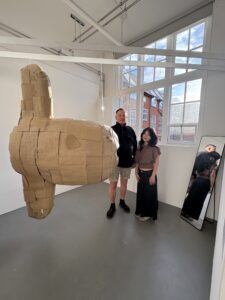
Darya Kan a fine art degree student exhibits her Sun fish installation.
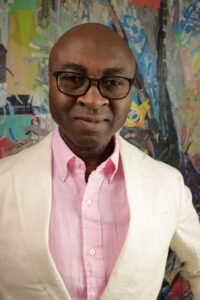
Hassan Aliyu
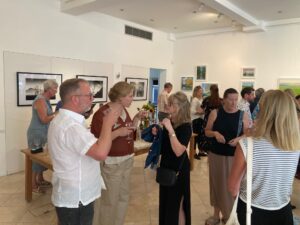
Gallery Director Anna Dempster in red entertains at Artspace 5-7
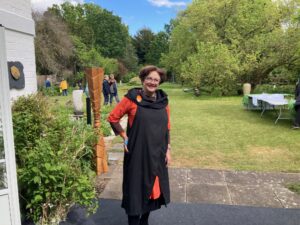
Art Conservator Penny Heath hosts the Art Garden
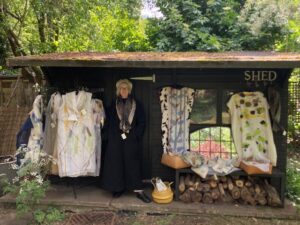
Dressmaker Artist Brenda Mayo
Listen to the podcast Cambridge Arts Roundup Episode 68
Artist Zhaniya Amantaveya
I am a fine art student at Anglia Ruskin University, with a foundation background in architecture, completed at Caspian University. My practice moves between fine art and applied design, combining conceptual thinking with practical execution.
I work across painting, installations, digital art, and visual identity, with a growing focus on how art operates in public, digital, and commercial spaces. Alongside my studio work, I collaborate with businesses and creatives on branding, content, and digital marketing.
Artist Statement
I work with mixed media, combining oil painting with found objects and installation. My practice explores bereavement, mourning, and cultural erasure through material contrast. These tensions mirror a state of sorrow that still holds the possibility of cultural revival. My installations are intentionally immersive and confrontational, forcing the viewer to face the uncomfortable realities of post-colonial trauma. Drawing from my personal and ancestral experiences of racism within my own country, I investigate how violence can occur not only physically but culturally through the erasure of memory, language, and tradition. A feeling of enslavness throught torture and stripped of memory acts as a central metaphor in my work. Forgetting one’s roots becomes a method of depersonalisation and, ultimately, the destruction of a nation. Through material, scale, and spatial arrangement, I aim to communicate the weight of national identity, not as blind patriotism or nationalism, but as an urgent act of remembrance. My intention is for viewers not only to see this pain, but to feel it, and to reflect on what is lost when collective memory is erased. I am an artists from Kazakhstan, post-soviet country in central Asia, born in 2003, 12 years after independence.
“Clause 16.12”, Digital collage, 29,7 x 42 cm x 3, 2026
I documented and repurposed mould-infested canvases into a digital collage. The mould produced organic, invasive patterns and a muted, decomposing colour palette that directly echoed my conceptual focus on decay, erosion, and systemic neglect. What initially appeared as damage became a visual metaphor for cultural and political deterioration.
This material language parallels ongoing developments in Kazakhstan, where state policy increasingly reflects the lingering dominance of Russian influence. Article 7, Clause 2 of the proposed constitutional framework maintains that Russian is used on an official basis alongside Kazakh within state institutions. While framed as administrative practicality, this policy reinforces a colonial linguistic hierarchy that continues to undermine the status of the Kazakh language in its own nation.
Public resistance to this policy was met not with dialogue, but with suppression. Protestors expressing dissatisfaction were detained, and authorities reportedly demanded the deletion of recorded evidence. The subsequent revision of the wording—from Russian being used “on an official basis” to being used “along with” Kazakh—functions less as meaningful reform and more as a superficial concession designed to diffuse criticism without addressing the structural imbalance. Kazakhstan’s continued recognition of Russian as an official or secondary language places it among a small group of post-Soviet states that have yet to fully dismantle the cultural and political residue of Soviet control.
Equally concerning is the narrowing of freedom of expression under Article 23, Clause 1, which now guarantees only “freedom of speech, scientific, technical, and artistic creativity.” This revision is not neutral; it is a deliberate act of limitation. By replacing the broader guarantee of “freedom of speech and creativity” with a categorised and restrictive definition, the state effectively determines which forms of expression are legitimate and which are not. Within the legal and linguistic frameworks of Kazakh and Russian, this shift risks excluding entire cultural practices—such as literature, music, and performance—from full protection.
Taken together, these changes signal a tightening control over both language and expression. Rather than fostering cultural autonomy, they suggest an environment in which identity is regulated, dissent is managed, and creativity is permitted only within state-defined boundaries. In this context, my use of mould, fragmentation, and reconfiguration operates not only as aesthetic choices, but as a direct response to systems that allow culture to decay while simultaneously restricting the means to challenge that decay.
“Steppe”, 2026, Yarn and chicken wire, 235*272 cm
This work explores the tension between cultural memory and imposed identity through material, form, and bodily process. Using chicken wire as the primary structure, I construct a
surface that simultaneously resembles and resists the traditional Kazakh carpet. Historically, carpets have functioned as both practical and spiritual objects—insulating space while
carrying encoded symbols of identity, protection, and belonging. In this work, however, that language is disrupted. The wire acts as a metaphorical cage. It suggests restriction, surveillance, and the lingering
presence of external control, reflecting how Western and colonial influences remain deeply embedded within contemporary Kazakh identity. Onto this rigid, industrial structure, I weave
traditional ornaments associated with freedom, rebirth, and new beginnings. Yet these symbols are not presented in their original context—they are fragmented, suspended, and
partially lost within the grid. The gaps in the wire become sites of absence, pointing to the erosion of cultural continuity and the quiet disappearance of memory. The use of red yarn intensifies this tension. Red carries layered cultural meanings: it signifies life, energy, passion, and ritual, but also power, aggression, and historical dominance. Its presence within the work oscillates between vitality and violence, suggesting that cultural
identity is not only something that survives, but something that is constantly negotiated and contested.
The making process itself is physically embedded in the work. The sharpness of the wire repeatedly marked my body, turning the act of construction into an experience of discomfort and resistance. These traces, although not always visible, are conceptually present: positioning the body as both a site of labour and a carrier of cultural tension.
Through this work, I am not attempting to reconstruct tradition in its original form. Instead, I expose its instability under pressure—how it stretches, fractures, and persists within systems
that both contain and reshape it. The piece exists in a state of contradiction: between protection and confinement, preservation and loss, past and present.
“Born of This Soil”, 2026, Acrylic Display Box, Soil, Amulet, Note. 28,7*23,7*24,4 cm
Born of This Soil explores the act of remembering, preserving, and honouring cultural traditions across distance and time. It reflects on national memory as something that must be activelycarried forward – protected, reinterpreted, and passed on to future generations. At its core, the
work is about connection: to land, to ancestry, and to a sense of belonging that persists even in displacement. As an international student living in the United Kingdom, with the possibility of building a life
away from my homeland, this connection becomes increasingly urgent. The physical distance from Kazakhstan intensifies the need to hold onto cultural identity, not as something fixed, but
as something that must be consciously maintained. Central to the work is the tumar, a traditional Kazakh amulet. Historically, it was used to carry soil from one’s homeland, ensuring that if a person died far from home, whether in travel or
war, they could still be symbolically returned. The act of placing that soil upon the body re-established a final connection to the land, collapsing distance even in death. Later, following the
spread of Islam, the tumar evolved to contain verses from the Qur’an, transforming it into a protective object that bridges spiritual and physical realms.In this work, the tumar becomes a vessel of memory, identity, and continuity. It represents theweight of origin: the idea that no matter how far one moves, there remains an unbreakable
bond to the place that formed them. Born of This Soil is ultimately a homage: to land, to history, and to the enduring presence of home within the self. It asks what it means to belong when one exists between places, and how
cultural memory can survive, adapt, and remain rooted.